
Most products still move through the same traditional linear economy model: extraction, manufacturing, usage, and ultimately disposal. This approach has driven economic growth for decades, but it’s becoming increasingly difficult to sustain.
That’s because in the modern business environment, raw material prices constantly fluctuate, supply chains face frequent disruptions, waste regulations are more stringent, and customers increasingly expect companies to reduce waste.
To overcome these challenges, organizations now view a circular economy as a practical alternative. Circularity enables them to operate more sustainably and, most importantly, improves how they create business value throughout a product’s lifecycle.
This article compares circular economy vs. linear economy to help you understand key dierences from a business perspective, not just in terms of industrial waste reduction.
Understanding the traditional linear economy
The linear economy is a value creation model that begins with resource extraction and ends with disposal. Businesses acquire raw materials, turn them into finished goods, and sell them to customers, who eventually discard those products as waste. That’s why it’s also called the take-make-dispose model.
Companies have been using the linear economy since the Industrial Revolution, when mechanization made it possible to manufacture products faster and at a much larger scale than ever before.
The linear model has worked for decades because cheap raw materials and mass production enabled businesses to meet growing consumer demand while keeping manufacturing costs low. Additionally, natural resources seemed inexhaustible, and industrial waste carried fewer economic or regulatory consequences because it was treated as the cost of progress rather than a corporate liability.
Why the linear economy is now reaching its limits
Today’s business environment is very different from the one in which the linear economy was developed. Companies now face challenges that expose the weaknesses of a system built on continuous resource extraction.
Global supply chains are increasingly vulnerable to disruptions (e.g., geopolitical conflicts), which make virgin material costs volatile. Additionally, governments are introducing stricter environmental rules. For example, companies that fail to comply with the EU’s corporate sustainability regulations risk paying fines of up to 3% of their global annual revenue.
The wastefulness of the linear economy is also becoming harder to ignore. Every product that ends up in a landfill represents materials that can no longer generate business value. According to the 2026 Circularity Gap Report, the world loses approximately €25.4 trillion annually because of inefficient resource use and premature product disposal.
All these challenges have made organizations rethink the traditional take-make-dispose model and explore alternatives.
What is a circular economy?
A circular economy is a value creation model that keeps products in use for as long as possible. Businesses that implement this approach minimize waste and remain competitive in an increasingly resource-constrained world by creating products that can be reused, repaired, refurbished, remanufactured, or eventually recycled.
Circularity applies throughout a product’s lifecycle. That means it begins long before an item reaches the recycling bin.
“In a properly built circular economy, [businesses] should rather focus on avoiding the recycling stage at all costs…Preventing waste from being created in the first place is the only realistic strategy”
World Economic Forum
If your organization is planning to switch to this economic model, you need to consider three key circularity principles:
Designing out waste
Keeping products in use
Regenerating natural systems
Designing out waste
Creating products with short life spans in order to sell more over time underutilizes limited resources and increases waste in landfills. Circularity prioritizes longevity.
In sustainable manufacturing, you intentionally design long-lasting products that can re-enter the economy at their end of life, which minimizes disposal and constant replacements. This approach is good for business because you can sell long-life products at a higher price than comparable alternatives with shorter lifespans.
“By shifting our mindset, we can treat waste as a design flaw. In a circular economy, a specification for any design is that the materials re-enter the economy at the end of their use”
Ellen MacArthur Foundation
Keeping products and materials in use
Instead of replacing products as soon as they wear out, businesses extend their useful life, which in turn unlocks new revenue streams.
Take Fairphone, for example. The Android smartphone company makes modular mobile devices with easily swappable parts. When phone components break or degrade, users can buy spare parts from the company’s online shop and get do-it-yourself installation instructions.
Businesses can also extend a product’s life cycle through a post-use recovery program. It involves collecting used products from customers. Organizations can then sell them as second-hand, refurbished, or remanufactured items. If a product has reached the end of its usable life, you can recycle its materials whenever possible.
Regenerating natural systems
Regenerating natural ecosystems involves actively restoring and improving the environment. Circular business models support this initiative by using sustainably sourced raw materials that allow ecosystems to regenerate.
This can help strengthen your brand’s reputation because stakeholders increasingly favor companies that demonstrate measurable environmental stewardship.
Circular economy vs linear economy: The biggest differences
How exactly is the circular economy different from the linear model? Here’s a detailed comparison.
Product design
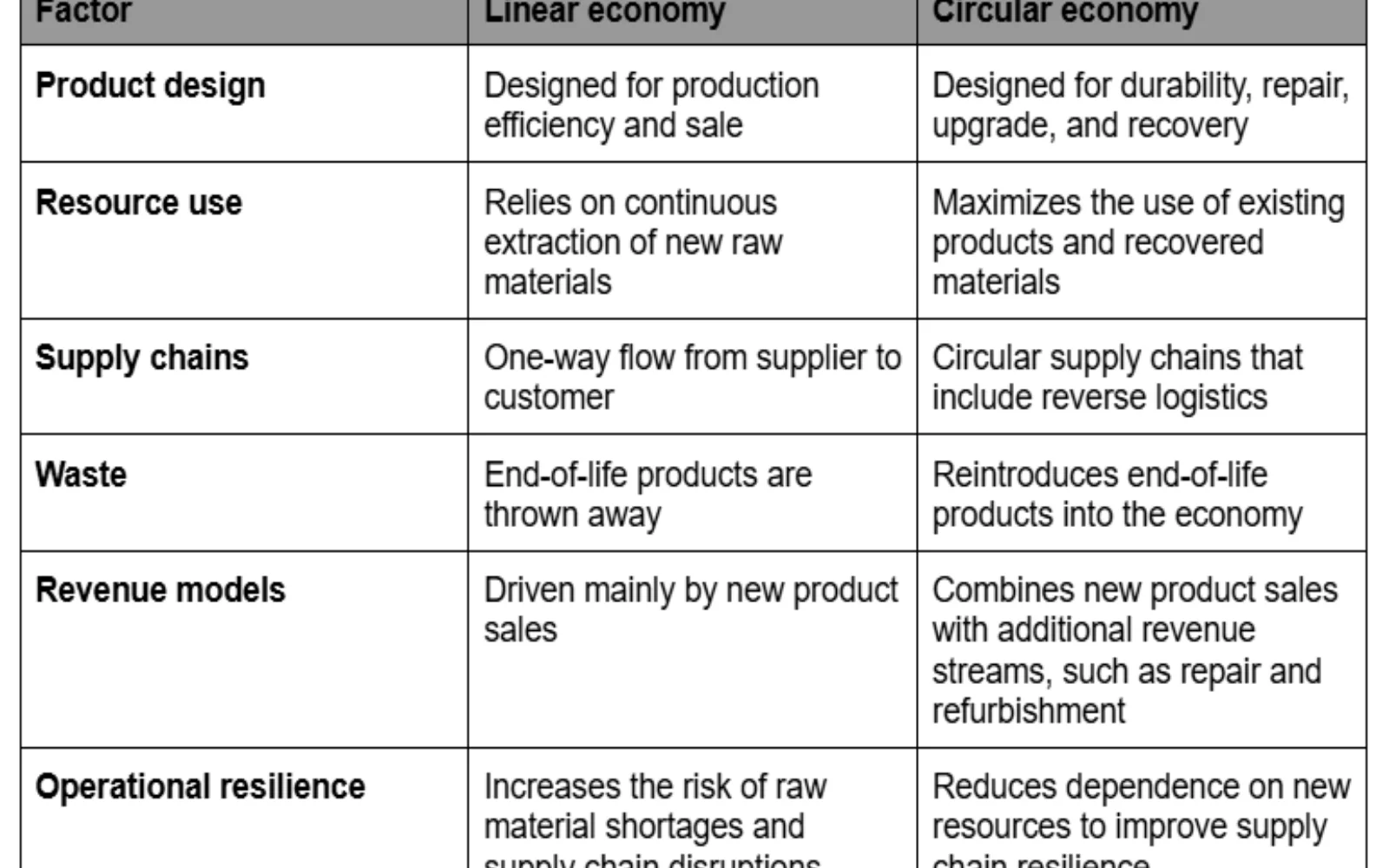
With a linear business model, you design products to perform their intended function at the lowest practical manufacturing cost — no consideration of repairability or end-of-life recovery.
A circular economy, on the other hand, focuses on building durable products that are easy to repair, upgrade, and disassemble. As a result, businesses can expand their products’ lifespan after the initial sale. And when the product reaches the end of its useful life, organizations can easily recover valuable components.
Resource use
The linear model relies on extracting new raw materials to manufacture goods. As production increases, so does the demand for virgin resources.
Circularity reduces the dependence on new raw materials by encouraging businesses to recover materials from returned or retired products. This enhances resource efficiency and reduces the risk of supply shortages.
Supply chains
In a linear model, supply chains primarily move raw materials to manufacturers and finished products to customers. Once products are sold, they typically exit the supply chain permanently.
In a circular economy, supply chains continue to capture business value after the initial sale by supporting reverse logistics. Customers can return old equipment for refurbishment or remanufacturing, which creates new revenue opportunities.
Waste
In a linear economy, businesses view waste as an unavoidable byproduct of production and consumption. Goods that reach the end of their lifespan are thrown away instead of being reused in the economy.
A circular economy, on the other hand, treats waste as a loss of economic value. Businesses seek to prevent waste by extending product life and recovering useful products or components through circular supply chains.
Revenue models
Business revenue in a linear economy comes from selling as many new products as possible. Income growth depends largely on increasing production and replacement purchases.
In a circular economy, organizations generate revenue throughout the product lifecycle rather than only at the point of sale. After the initial sale, they can diversify their income through repairs, refurbishment, maintenance, remanufacturing, leasing, product-as-a-service subscriptions, and second-hand resale programs.
Operational resilience
Since the linear economy heavily depends on new raw materials, businesses are more vulnerable to supply chain disruptions and price volatility.
The circular economy offers more operational resilience. By extending product life and recovering materials, companies are less reliant on continuous resource extraction. This improves supply chain stability and reduces procurement risks.
Here’s a summary of the circular economy vs. linear economy.
Why businesses are moving towards circular models
Rising raw material costs, resource scarcity, and frequent supply chain disruptions in the modern business environment have revealed the risk of relying on the traditional take-make-dispose model. Circularity reduces exposure to these challenges by prioritizing reusing existing materials over extracting new ones.
Additionally, governments worldwide have introduced extended producer responsibility (EPR) regulations. Depending on jurisdiction, EPR legislation may include:
Take-back rules that mandate manufacturers to manage the collection, recycling, or safe disposal of their products post-consumption
Eco-design product requirements that facilitate reentry of used materials into the economy and minimize waste (design for circularity)
Since a circular business model keeps materials in use for as long as possible and reduces waste, it aligns closely with EPR requirements.
Customers and investors also expect businesses to reduce waste and improve sustainability. In Deloitte’s 2024 survey, 45% of consumers expect businesses to offer sustainable products or services. Meanwhile, 88% of investors prefer to invest in companies that consider sustainability. Waste reduction and sustainability are core principles of a circular economy.
By helping companies reduce waste, recover valuable materials from post-use products, and extend product lifecycles, a circular model promotes supply chain resilience. It also gives businesses a competitive advantage in an economy with increasingly limited resources.
Promoting long-term success with circular business models
A circular economy is more than a waste management or sustainability initiative. It’s a business model that helps companies create more value from existing products instead of solely relying on new raw materials.
By extending product lifecycles and recovering valuable materials, businesses with circular economic models can reduce costs, improve supply chain resilience, and adapt more easily to changing market conditions. These perks can strengthen your competitive advantage and promote long-term business success.
However, circularity implementation varies by industry. Partnering with an expert like Oaklyth can help you adapt circular practices tailored to your sector and goals. Reach out today to see how we help turn your circular ambition into action.